By a Concerned Member of the Bar
As the Nigerian Bar Association (NBA) Kano Branch prepares to elect a new set of officers tomorrow the 20th of June 2026, members of the Branch are once again presented with an opportunity that extends beyond merely filling elective offices. The election is fundamentally about deciding the values, temperament, integrity, and leadership culture that should define one of the most vibrant branches of the Nigerian Bar Association.
The office of the Branch Chairman is not ceremonial. It is perhaps the most demanding leadership position within the Branch. The Chairman serves as the public face of the NBA, interfaces with the Judiciary, Government, security agencies, and the public, while simultaneously providing leadership to lawyers with diverse opinions and interests. Such an office requires patience, emotional maturity, restraint, and unquestionable respect for institutional processes.
It is against this background that concerns have continued to be raised regarding one of the chairmanship candidates in the forthcoming NBA Kano Branch elections.
A History That Cannot Be Ignored
Publicly available records within the Branch indicate that following allegations of professional misconduct made against the aspirant, the matter was deliberated upon by the Branch. Rather than allowing the internal disciplinary mechanisms to run their course, it is alleged that the aspirant lodged a criminal complaint with the Nigeria Police Force against the then Branch Chairman and the Chairman of the Branch Disciplinary Committee.
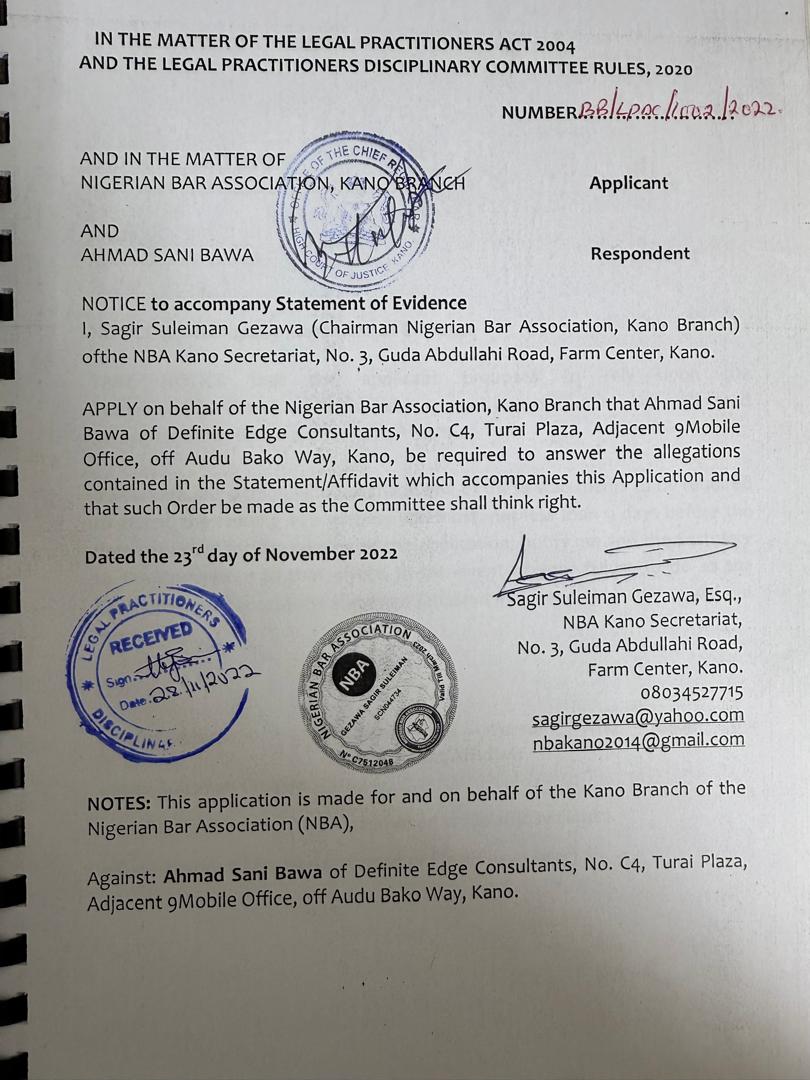
Thereafter, following a resolution of the Branch, a petition was forwarded to the Legal Practitioners Disciplinary Committee (LPDC), titled:
Nigerian Bar Association, Kano Branch v. Ahmad Sani Bawa, Petition No. BB/LPDC/1002/2022.
The existence of such proceedings, whether ultimately determined in favour of or against the respondent, is a matter that members deserve to know and objectively evaluate when considering the suitability of any aspirant for the highest office in the Branch.
Leadership is not merely about legal competence; it is equally about how one responds to criticism, institutional accountability, and disagreement.
Recent Incidents Raise Further Questions
Even more concerning are reports of more recent incidents involving the same aspirant.
It has been alleged that during a civil discussion which he turned into an altercation with a serving member of the Executive Committee of the Branch, the Chairmanship candidate physically grabbed the lawyer by the neck and attempted to assault him. Witnesses further allege that derogatory remarks were made during the confrontation, including a statement to the effect that “when slave was slave trade, we sold people”, he further said, “I have sold people more worthy than you.”
If these allegations are accurate, they portray conduct that falls far below the level of dignity expected of a prospective Chairman of the NBA.
Lawyers are expected to resolve disagreements through dialogue, reason, and institutional mechanisms—not intimidation or physical confrontation.
Conduct Before the Court
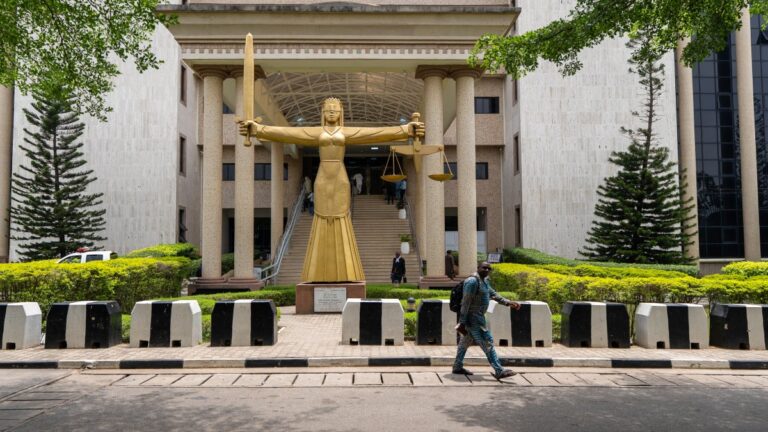
Equally disturbing are reports concerning proceedings before the Federal High Court, where the aspirant was allegedly directed by the presiding Judge to remove his wig and gown and take his place in the dock after exhibiting unprofessional conducts.
According to accounts circulating within the legal community, after the court adjourned briefly and later resumed, the aspirant had allegedly left the courtroom without the leave of the court.
While every individual remains entitled to the presumption of innocence and to due process, incidents involving alleged courtroom disobedience inevitably raise legitimate concerns about respect for judicial authority and professional discipline.
Members of the Bar are entitled to ask whether such conduct reflects the temperament expected of the person who seeks to lead lawyers in one of Nigeria’s foremost NBA branches.
Questions for the Electoral Committee
Perhaps the most troubling aspect of this election is not merely the allegations surrounding a candidate, but the apparent absence of rigorous scrutiny during the screening process.
Many members have questioned whether meaningful interviews were conducted before candidates were cleared.
If a candidate with publicly known disciplinary history, documented institutional disputes, and other controversies could obtain clearance without apparent interrogation of these issues, then serious questions arise regarding the effectiveness of the Electoral Committee’s vetting process.
Screening should never be reduced to a mere administrative exercise.
It is intended to assure members that every cleared candidate possesses not only the constitutional qualifications but also the character, temperament, and leadership qualities expected of the office sought.
The Membership Question
Another issue that has generated discussion among members is the reported appearance of the aspirant’s name on the membership list of the NBA Ungoggo Branch.
If accurate, this naturally raises questions requiring clarification regarding branch membership and eligibility under the relevant provisions governing participation in the elections of the Kano Branch.
Transparency on such matters is essential, not merely for this election but for preserving confidence in future electoral processes.
This Election Is About the Future of the Branch
The NBA has consistently positioned itself as the conscience of society, advocating for constitutionalism, due process, human rights, and institutional integrity.
Those who aspire to lead the Association must themselves embody these ideals.
Leadership demands patience under pressure.
Leadership demands respect for institutions.
Leadership demands emotional intelligence.
Leadership demands the ability to disagree without hostility.
Most importantly, leadership demands character.
The members of the NBA Kano Branch deserve a Chairman whose conduct inspires confidence within the Bar, earns respect from the Bench, and reassures the public that the legal profession remains committed to the highest ethical standards.
As voting day approaches, members must look beyond campaign promises and carefully evaluate the records, temperament, judgment, and institutional respect demonstrated by every candidate.
The future of the Branch deserves nothing less.
About the Author